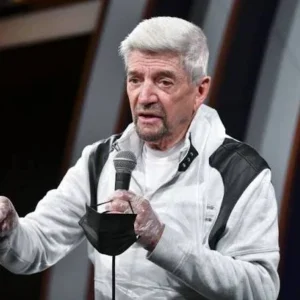
A Pioneer of Stand-Up Comedy Takes His Final Bow
TTom Dreesen Obituary, LOS ANGELES, CA — The entertainment world has lost a towering figure. On Wednesday, June 17, 2026, Tom Dreesen, the legendary stand-up comedian, acclaimed actor, author, and beloved opening act for Frank Sinatra, passed away at the age of 86. For more than five decades, Dreesen’s name was synonymous with classic American showmanship, impeccable timing, and a brand of storytelling that bridged generations and cultural divides. From his humble, poverty-stricken roots in the south suburbs of Chicago to the glittering stages of Las Vegas and the iconic couch of The Tonight Show, Dreesen’s life story reads like the ultimate American dream.
The Breaking News and Family Statement
The news of Dreesen’s passing was confirmed early Wednesday morning through a heartfelt statement released by his family. The announcement immediately sent ripples of mourning throughout Hollywood, the stand-up comedy community, and philanthropic circles nationwide. “For more than five decades, Tom Dreesen brought laughter, heart, and humanity to audiences across America,” the family wrote. “A proud native of Harvey, Illinois, Tom built a remarkable career through perseverance and talent. Beyond the stage, Tom was a devoted father, brother, grandfather, friend, mentor, storyteller, and motivator.” The family respectfully requested privacy as they navigated their grief, while simultaneously expressing deep gratitude to the millions of fans who had supported him throughout his extraordinary journey. Within hours, tributes poured in from fellow comedians, actors, and public figures, all echoing a singular sentiment: Tom Dreesen was one of the kindest, most professional, and genuinely funny men to ever hold a microphone.
A Legacy Forged in Laughter and Resilience
When you examine the full scope of Tom Dreesen’s legacy, it is impossible to compartmentalize him as simply a comedian. He was a trailblazer who actively dismantled racial barriers in the 1960s. He was a fierce labor advocate who stood on the picket lines to ensure future generations of comics would be paid for their craft. He was the trusted confidant of the biggest musical icon of the 20th century. Furthermore, his media presence was characterized by a rare dignity that allowed him to transcend the petty squabbles and controversies that so often sink modern celebrities. Dreesen proved that you did not need to rely on vulgarity, shock value, or cruelty to captivate an audience. He commanded the stage with a sharp suit, a warm smile, and an unparalleled mastery of the human experience.
From the Streets of Harvey to the United States Navy
To truly understand the depth of Tom Dreesen’s comedic genius, you have to look back at the environment that forged him. Comedy, at its best, is a coping mechanism for tragedy and hardship. For Dreesen, the humor was a necessary survival tool cultivated in an environment where laughter was often the only luxury his family could afford.
The Grinding Poverty of a South Suburban Childhood
Born on September 11, 1939, in Chicago, Illinois, Tom Dreesen was raised in the nearby industrial suburb of Harvey. He was the third child in a sprawling, deeply impoverished family of eight. Life in Harvey during the mid-20th century was defined by blue-collar grit, smoke-stack industries, and neighborhoods where everyone was fighting just to keep the lights on. Dreesen’s childhood was marked by a relentless struggle against absolute poverty. In numerous interviews, he recalled growing up in a shack with no running water and no central heating, relying on a potbelly stove to survive the brutal Midwestern winters. This environment could have easily bred resentment or despair, but for Dreesen, it became a laboratory for observational humor. He learned early on how to read a room, defuse tension, and use his natural charisma to navigate a world that offered very few handouts.
Shoeshines, Bowling Alleys, and a Hustler’s Mentality
From the moment he was old enough to walk, Dreesen was working. He didn’t have the luxury of a carefree childhood. Instead, he developed an incredible work ethic, taking on any odd job he could find to help support his struggling siblings. He sold and delivered newspapers on freezing street corners. He hauled his wooden shoeshine box into local taverns, polishing the shoes of factory workers and local toughs while absorbing their stories, their cadences, and their jokes. He worked late into the night setting up pins in smoke-filled bowling alleys. These early jobs did more than just put loose change in his pocket; they provided a masterclass in human psychology. When you are shining shoes in a dive bar, you learn how to talk to anyone, from the wealthiest local businessman to the most down-on-his-luck regular. This uncanny ability to connect with people from all walks of life would become the secret weapon of his future stand-up career.
Military Service and Finding Direction
Despite his innate intelligence, the chaotic nature of his home life took a toll on his formal education. Dreesen attended Thornton Township High School, but feeling alienated and running with a tough crowd, he made the difficult decision to drop out during his sophomore year. Knowing he was heading down a dangerous path with few prospects in Harvey, he enlisted in the United States Navy at the age of 17. The military provided exactly what the young Dreesen desperately needed: structure, discipline, and a sense of broader purpose. His time in the Navy broadened his horizons, taking him far away from the south suburbs of Chicago and exposing him to the wider world. It was also during this period that he married his first wife, Maryellen Subock, and began to build a family of his own. By the time he returned to civilian life, Dreesen was no longer a rebellious teenager; he was a disciplined young father ready to tackle whatever life threw at him.
Tim and Tom: Shattering Racial Barriers in the Civil Rights Era
Following his military service, Dreesen returned to Illinois and worked a grueling succession of manual labor jobs—construction work, bartending, anything to pay the rent for his growing family. Eventually, guided by advice from his older brother, he pivoted to selling life insurance. It was a white-collar job that required charm, persuasion, and the ability to handle constant rejection—skills perfectly suited for a future comedian. To improve his networking, he joined the local Jaycees chapter. It was there that a chance encounter would alter the course of comedy history.
Meeting Tim Reid and the Birth of a Groundbreaking Duo
At the Jaycees, Dreesen crossed paths with Tim Reid, a charismatic Black man who shared Dreesen’s sharp wit and ambition. The two quickly struck up a deep friendship. At the time, Dreesen had harbored a secret dream of becoming a comedian, a seemingly impossible goal for an insurance salesman from Harvey. Encouraged by their mutual chemistry, the two decided to take a massive leap of faith and form a stand-up comedy duo in 1968. They called themselves “Tim and Tom.” What made this act so revolutionary was not just their undeniable talent, but the visual reality of their partnership: they were the very first biracial stand-up comedy duo in the history of the United States.
Navigating the Cultural Powder Keg of 1968
To understand the courage required to launch Tim and Tom, one must look at the historical context of 1968. It was one of the most volatile years in American history, marked by the assassinations of Martin Luther King Jr. and Robert F. Kennedy, widespread race riots, and deep societal division. In this incredibly tense atmosphere, a Black man and a white man taking the stage together to joke about race relations was nothing short of radical. Under the guidance of radio personality Vince Sanders, who managed their business affairs, Tim and Tom toured the country. They performed at iconic venues like Mister Kelly’s on Rush Street in Chicago, but they also faced aggressive, segregated crowds. They endured hostility from white audiences who didn’t want to see a Black man on stage, and skepticism from Black audiences who didn’t trust the white guy next to him. Yet, through brilliant, cutting-edge writing that highlighted the absurdity of racism, they forced audiences to laugh together. They were doing the heavy lifting of civil rights work through the medium of stand-up comedy.
The Solo Breakout and Hollywood Calling
Despite their immense critical success and the sheer historical importance of their act, the financial realities of the road were brutal. The pair struggled to make a sustainable living, and by the mid-1970s, they mutually and amicably agreed to part ways. Both men, however, were destined for massive solo success. While Tim Reid went on to television stardom as Venus Flytrap on WKRP in Cincinnati, Tom Dreesen packed up his family and headed to California. The solo transition was daunting, but Dreesen had honed an incredibly polished, observant comedic voice. He quickly established himself as a dominant force in the Los Angeles comedy scene, preparing for the television breakthrough that would change his life forever.
Conquering Late-Night Television and the Johnny Carson Couch
In the modern era of TikTok, YouTube, and fragmented streaming platforms, it is difficult to adequately convey the monolithic power that late-night television held in the 1970s and 1980s. There was no internet; there were only a handful of networks. If you wanted to be a star, there was exactly one path: you had to get on national television, and you had to kill.
Over 500 National Television Appearances
Tom Dreesen’s television resume is, frankly, staggering. Throughout his career, he amassed more than 500 appearances on national television. He was a ubiquitous media presence, appearing on everything from Match Game to Beat The Clock. He seamlessly transitioned into the talk show circuit, becoming a favorite of David Letterman, Jay Leno, and Merv Griffin. Dreesen was the ultimate reliable guest. Producers knew that if they booked Tom, they were guaranteed a tight, flawlessly executed set that would charm the studio audience and play perfectly to middle America. He even served as a frequent guest host for The Late Show, proving his versatility not just as a performer, but as an engaging conversationalist and interviewer.
The Ultimate Validation: Earning Johnny’s Approval
However, the absolute pinnacle of stand-up comedy during Dreesen’s era was The Tonight Show Starring Johnny Carson. An appearance on Carson was the ultimate kingmaker; a solid set and an invitation to sit on the couch could transform a struggling comic into a millionaire overnight. Tom Dreesen didn’t just appear on Carson once or twice. He performed on The Tonight Show an astonishing 60 times. Carson, who was notoriously discerning and highly critical of comedians, adored Dreesen’s polished style and Midwestern sensibilities. Dreesen’s observational humor about his poor upbringing, his Catholic guilt, and the absurdities of daily life resonated deeply with Carson. Sitting next to Johnny was the ultimate validation for the kid who used to shine shoes in Harvey, cementing Dreesen’s status as late-night royalty.
Acting Credits: From Murder, She Wrote to Spaceballs
Beyond the stand-up microphone, Dreesen proved to be a highly capable actor. His natural cadence and everyman appeal translated perfectly to scripted television. He landed guest roles on some of the biggest television programs of the era, including Murder, She Wrote, Columbo, and Touched by an Angel. He also made a memorable foray into feature films, most notably appearing in Mel Brooks’ beloved 1987 sci-fi comedy parody, Spaceballs. Whether he was delivering a dramatic monologue on a procedural crime show or playing a comedic foil on the big screen, Dreesen brought a profound sense of professionalism and grounded reality to every role he inhabited.
The Sinatra Years: 14 Years Alongside the Chairman of the Board
While his television and film credits are vast, the most legendary chapter of Tom Dreesen’s career is undeniably his 14-year tenure as the opening act for Frank Sinatra. It was a partnership that redefined Dreesen’s life, elevating him from a successful club comic to a global touring phenomenon.
Catching Frank Sinatra’s Eye
Frank Sinatra was notoriously demanding of his opening acts. He required someone who could warm up an arena of thousands of impatient fans waiting to see the Chairman of the Board, but without resorting to dirty jokes or cheap crowd work. Sinatra needed pure, unadulterated class. Dreesen fit the bill perfectly. His clean, sharply written observational humor appealed to Sinatra’s old-school sensibilities. After a highly successful trial run, Sinatra personally asked Dreesen to join him on the road permanently. For the next decade and a half, Dreesen traveled the globe, performing in the most prestigious venues on earth—from sold-out arenas in London to massive amphitheaters in Japan, and of course, the grandest stages of Las Vegas.
Life Lessons from the Ultimate Showman
The professional relationship quickly blossomed into a deeply personal friendship. Dreesen became a surrogate son to Sinatra. The comedian would often remark that Sinatra gave him far more life advice than his own biological father ever did. They bonded over their shared working-class roots, their deep Italian-Catholic faith (Dreesen later discovered his biological father was Italian), and their uncompromising dedication to the craft of entertainment. In late-night, post-show conversations spanning midnight masses and private flights, Sinatra taught Dreesen about loyalty, the mechanics of high-level show business, and the importance of taking care of your friends. Dreesen witnessed a softer, generous side of Sinatra that the press rarely covered—moments where Sinatra would secretly pay for the medical bills of struggling musicians or stop his limousine to sign an autograph for a crying fan.
The Toughest Gig: Emceeing Sinatra’s Funeral
When Frank Sinatra passed away in 1998, the devastation Dreesen felt was profound. He hadn’t slept for 40 hours when he arrived at the Good Shepherd Church in Beverly Hills to perform the most difficult gig of his life: acting as the master of ceremonies for Sinatra’s wake. Standing before a crowd of Hollywood titans—Gregory Peck, Kirk Douglas, Don Rickles—Dreesen held his composure. He knew Sinatra would have wanted the room to laugh, to keep things light, and to keep the speeches under ten minutes. As a pallbearer, Dreesen helped carry his idol, his mentor, and his dearest friend to his final resting place, cementing a brotherhood that remains one of the most beautiful stories in show business history.
The 1979 Comedy Store Strike and the Evolution of Performers’ Rights
While his association with Sinatra highlighted his traditional showbiz roots, Dreesen was also a fierce advocate for the modern labor rights of entertainers. One of the most critical, yet historically underappreciated, elements of Dreesen’s legacy was his involvement in the 1979 Comedy Store strike. This event forever altered the legal philosophy and economic structure of the stand-up comedy industry.
The Concept of “Showcasing” vs. Worker Exploitation
In the late 1970s, Los Angeles was the undisputed mecca of stand-up comedy, with Mitzi Shore’s Comedy Store operating as the ultimate gatekeeper. At the time, the legal philosophy governing comedy clubs was heavily skewed in favor of club owners. Shore operated under the premise that stage time was a “showcase.” Comedians were not viewed as labor; they were viewed as lucky participants receiving exposure. Consequently, the club pulled in massive profits from cover charges and drink minimums, while the comedians who actually drew the crowds were paid absolutely nothing. As the cost of living in Los Angeles rose, comedians began to realize that exposure could not pay the rent.
Dreesen on the Picket Lines
In the spring of 1979, the comedians organized. They demanded a modest wage for their performances. When Shore refused, the comedians went on strike. Tom Dreesen, who by this point had already established a successful television career and did not strictly need the club money, stood in solidarity with his younger, struggling peers. He understood that the issue transcended money; it was about dignity and fair labor practices. Dreesen picketed outside the Comedy Store, using his media presence and industry clout to bring national attention to the strike. His involvement lent immense credibility to the movement, proving this was not just a group of whiny amateurs, but a legitimate labor dispute involving top-tier talent.
Transforming the Legal Status of Comedians
The strike lasted six weeks and was ultimately successful, resulting in an agreement where comedians were finally paid for their sets. More importantly, it established a massive shift in the legal classification of performers. Comedians were formally recognized as independent contractors performing a valuable service, rather than volunteers. This precedent laid the groundwork for modern entertainment labor laws, ensuring that the intellectual property and physical labor of stand-up comics possessed intrinsic, legally protected financial value. Dreesen’s courage to stand up against the establishment demonstrated a deep-seated commitment to justice that traced back to his blue-collar roots in Harvey.
Legal Philosophy and Modern Entertainment Law: From Dreesen’s Era to Today
When analyzing Tom Dreesen’s career, one must look at how the legal philosophy of the entertainment industry has drastically evolved since his prime. Dreesen operated in an era that relied heavily on personal handshakes, unwritten codes of conduct, and an inherent sense of old-school professionalism. Today, the entertainment landscape is heavily regulated by complex legal frameworks, driven by past abuses and the modern intersection of media and the law.
The Stark Contrast of the Weinstein Era and Performer Safety
Dreesen’s advocacy during the 1979 strike was a fight for financial compensation and proper labor classification. However, the legal philosophy surrounding performer rights has since expanded drastically into the realm of physical safety and institutional accountability. The contrast between the honorable way Dreesen conducted his career and the horrific, predatory environment exposed by the MeToo movement is profound. The downfall of figures like Harvey Weinstein highlighted a severe failure in entertainment law, where non-disclosure agreements (NDAs) and corporate complicity were weaponized to protect abusers. Weinstein’s legal cases fundamentally shifted the philosophy of studio liability, resulting in new legislation that outlaws the use of NDAs in cases of sexual harassment and mandates strict workplace safety protocols for performers. Dreesen’s legacy as a true gentleman of the industry serves as a stark reminder of the ethical standards that were so violently discarded by the power brokers of the modern era. He proved that massive success in Hollywood never required the exploitation of others.
Defamation, First Amendment, and the Giuliani Parallels
Another major shift in legal philosophy involves the very content of comedy itself. Historically, comedians operated under an implicit “jester’s privilege,” largely shielded from defamation lawsuits because their acts were legally recognized as hyperbole or satire. Today, however, the boundaries between political commentary, comedy, and actionable defamation have become incredibly porous. This is acutely evident in the modern legal battles surrounding public figures like Rudy Giuliani. Giuliani’s aggressive defamation lawsuits—and the massive defamation judgments levied against him in turn—demonstrate how precarious public speech has become. Comedians and commentators who engage in political attacks today must navigate a highly litigious minefield, constantly weighing the First Amendment against the legal standard of “actual malice.”
The Timeless Protection of Clean, Observational Humor
Tom Dreesen masterfully avoided this legal and cultural quagmire through his devotion to clean, observational humor. He did not build his act on vicious political takedowns or defamatory character assassinations. By focusing on the shared human experience—growing up poor, dealing with family quirks, navigating relationships—he insulated his media presence from the toxic legal battles that define much of today’s discourse. Dreesen’s philosophical approach to comedy was one of unification rather than division. He understood that a joke that punches down might get a temporary laugh, but a joke that connects people across ideological lines creates a timeless legacy.
A Pillar of Philanthropy and Community Impact
Beyond the spotlight, Tom Dreesen’s life was defined by an extraordinary commitment to philanthropy. He understood that his fame and financial success were a privilege, and he utilized his platform to drive massive community impact, particularly for causes that touched his own family.
A Promise to Darlene: Battling Multiple Sclerosis
One of the most deeply personal drivers of Dreesen’s charitable work was the tragic loss of his older sister, Darlene. Growing up in Harvey, Darlene was Dreesen’s protector, holding his hand and guiding him through the chaotic streets of their youth. Tragically, Darlene was diagnosed with Multiple Sclerosis (MS) and passed away at an unthinkably early age. The devastation of watching his beloved sister suffer propelled Dreesen into action. He dedicated decades of his life to raising money and awareness for MS research. He hosted charity golf tournaments, leveraged his celebrity connections, and spoke passionately at fundraising galas, turning his personal heartbreak into millions of dollars for medical research.
Honoring the Uniform with the Gary Sinise Foundation
As a proud veteran of the U.S. Navy, Dreesen never forgot the men and women who serve in the armed forces. He became a highly active and vocal supporter of the Gary Sinise Foundation, working closely with actor Gary Sinise to support wounded veterans, first responders, and their families. Upon hearing of Dreesen’s passing, Sinise offered a deeply moving tribute, stating, “This morning America lost one of our great comedians and patriots, and I lost a dear friend.” Dreesen frequently visited military bases, performed at USO shows, and utilized his motivational speaking talents to uplift soldiers suffering from PTSD and physical injuries.
A Blueprint for Giving Back to the Community
Dreesen’s community impact extended back to his hometown of Harvey, Illinois, where he continually funded local educational initiatives and youth programs. He wanted to ensure that kids growing up in the same grinding poverty he experienced knew that a way out was possible. Through his motivational speaking and his bestselling book, Still Standing… My Journey from Streets and Saloons to the Stage, and Sinatra, Dreesen provided a blueprint for resilience. He taught that true success is not measured by the size of your bank account or the number of television appearances you make, but by the number of hands you reach down to pull up behind you.
Frequently Asked Questions About Tom Dreesen
Who was Tom Dreesen? Tom Dreesen was an iconic American stand-up comedian, actor, and author. He was renowned for making over 500 appearances on national television, including 60 appearances on The Tonight Show Starring Johnny Carson, and for serving as Frank Sinatra’s opening act for 14 years.
What was the Tim and Tom comedy duo? Formed in 1968, Tim and Tom was the first biracial stand-up comedy duo in American history. Comprising Tom Dreesen and Tim Reid, the act brilliantly tackled race relations during the height of the civil rights movement, breaking down social barriers through comedy.
How long did Tom Dreesen open for Frank Sinatra? Tom Dreesen served as the exclusive opening act for Frank Sinatra for 14 years. They toured the globe together, and their professional relationship evolved into a deep personal friendship. Dreesen eventually served as a pallbearer and the master of ceremonies at Sinatra’s funeral in 1998.
What was Tom Dreesen’s role in the 1979 Comedy Store strike? Despite being a successful and established comedian at the time, Dreesen supported the 1979 strike against the Comedy Store in Los Angeles. He picketed alongside younger comics to demand fair pay, which fundamentally changed the labor laws and legal classification of comedians from unpaid showcase acts to paid independent contractors.
What caused the death of Tom Dreesen? Tom Dreesen died at the age of 86 on June 17, 2026. While the family confirmed his passing early that Wednesday morning, specific medical details regarding his cause of death were kept private as the family requested time to mourn.
Remembering an Entertainment Icon
The passing of Tom Dreesen marks the end of an era in American entertainment. He was one of the last remaining threads connecting modern show business to the golden age of the Las Vegas crooners and the foundational days of the Los Angeles comedy boom. Dreesen’s life is a testament to the power of perseverance. He took the profound hardships of a poverty-stricken childhood in Harvey, Illinois, and spun them into a tapestry of comedic brilliance that delighted millions.
Whether he was breaking down racial barriers with Tim Reid, fighting for the legal rights of his fellow performers on the picket lines, warming up an arena for Frank Sinatra, or raising millions of dollars in memory of his sister, Tom Dreesen moved through the world with an unwavering moral compass. He proved that you can be wildly successful in Hollywood while remaining fundamentally decent. As the lights dim on his incredible 86-year journey, Tom Dreesen leaves behind a legacy of laughter, loyalty, and an enduring reminder that the greatest act any person can perform is one of kindness. The curtain has fallen, but the echoes of his laughter will resonate in the halls of comedy forever.